
A growing company needs an ERP partner that is neither too small to cope nor too big to care. The Odoo Gold Partners below work with mid-sized businesses and the ones heading there.
Eight names make the list. Brainvire and Control ERP lead, and six more Gold-tier partners follow. Growth rewards patience, so match the partner to the size you will be in three years, not the size you are today.
1. Brainvire
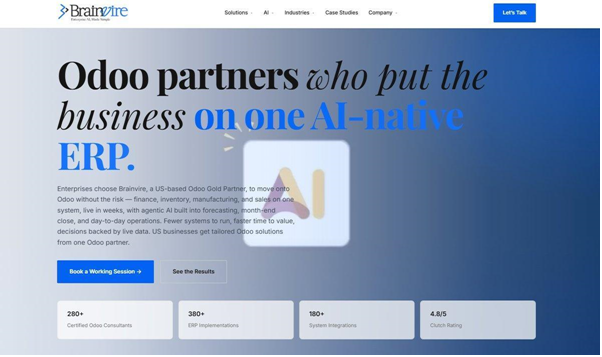
Brainvire is a Texas-headquartered Odoo Gold Partner with US offices in Irving, Plano and Hicksville and delivery hubs in Dubai, Mumbai and Singapore. Its Gold status covers the USA, Canada, APAC and EMEA, and its consultants are Odoo 19 certified.
Brainvire reports 280+ certified Odoo consultants, 380+ completed implementations, 180+ integrations and a 4.8/5 Clutch rating. Odoo named it a Best Partner North America 2025 finalist, and the 95% retention it reports across 2,000+ brands points to repeat business.
Partnerships with Adobe, Shopify Plus, OpenAI, Microsoft, SAP, Salesforce and Databricks let Brainvire connect Odoo to almost any surrounding system. Its flagship case moved a Fortune 500 fuel and energy retailer onto one Odoo 18 ERP and POS platform across 700+ sites in 12 countries. Discovery workshops turn a loose ERP wish list into a costed, phased plan before any build starts. A discovery workshop that ends in a phased, costed plan lets mid-sized companies start with the modules they need and add the rest later.
What Brainvire Delivers
- Implementation
- Migration and Upgrades
- Customization and App Development
- Odoo.sh Hosting and DevOps
- Third-Party and ERP Integration
- Support and AMS
- POS and eCommerce
- BI and Analytics
Industries: Retail, Store Solutions, Manufacturing, Jewelry, Automotive, Real Estate, Healthcare, Education, Logistics.
Odoo ERP implementation at Brainvire is a business program, not a software install. Odoo ERP consulting, managed hosting and application management support back each project.
2. Control ERP
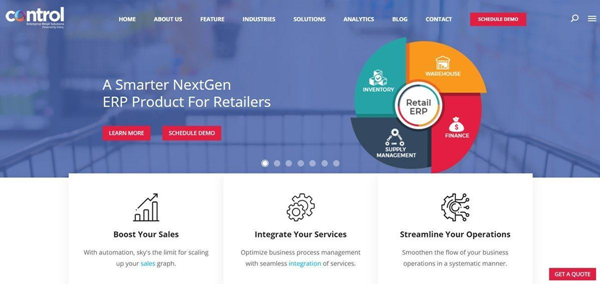
Plano-based Control ERP skips the blank-canvas build: its Odoo platform for omnichannel retail arrives with sales, purchasing, accounting, inventory, production, POS, CRM, HR and payroll, and eCommerce already joined, which shortens the time to live trading.
What sets Control ERP apart is commerce: native Magento integration, an eCommerce-ready CRM and built-in marketplace connectivity put online and offline sales in one place, while central inventory in Odoo and Magento stops web and shop floor counts drifting apart. Portfolio entries include an omnichannel ERP for Tent and Table and a retail omnichannel build for a mobile accessory seller.
Platform Highlights
- Omnichannel retail ERP on Odoo
- Native Magento integration
- Built-in marketplace connectivity
- Centralized multi-channel inventory
- Integrated POS, CRM and accounting
- HR, payroll and reporting in one system
Best for: growing retailers that want a ready-built platform they can extend later.
3. Odoo Experts B.V.
Odoo Experts B.V., in Zaandam, calls itself the number one Odoo Gold Partner in the Netherlands. It has 6 to 25 certified consultants and positions its work around smoother digital transformation and streamlined business processes.
Best for: Dutch companies that want a local team focused on process optimization.
4. Aardug
Aardug is a long-standing Dutch Odoo Gold Partner that builds projects around standard Odoo features, with a practical approach and a certified team of 6 to 25 consultants.
Best for: Dutch mid-market businesses that prefer standard Odoo with a practical approach.
5. Novobi
Novobi, from Austin, Texas, is an Odoo Gold Partner with 200+ implementations and 500,000+ hours of Odoo work by its own count. It is aimed at multichannel retail, wholesale and distribution businesses that want a quick, low-risk go-live.
Best for: mid-market sellers that want a fast go-live on proven workflows.
6. Sinova
Bogotá-based Sinova is an Odoo Gold Partner serving Latin American SMEs and mid-market firms across retail, logistics, healthcare and construction.
Best for: businesses in Colombia and the wider Latin American market.
7. Bista Solutions
Bista Solutions is a North American Odoo Gold Partner that cites 300+ Odoo implementations and several Best Partner awards from Odoo. Offices include one in Plano, Texas, and its published offer spans retail, eCommerce, manufacturing, utilities and construction.
Best for: North American companies that want a long-established partner with a wide industry record.
8. Cudio
Boston’s Cudio specializes in Odoo for complex, omnichannel businesses in manufacturing, distribution and retail. Across 16+ years of Odoo work it has completed 50+ projects, including migrations off SAP, Dynamics, NetSuite, Oracle, Sage and QuickBooks, and it reports 97% retention.
Best for: complex omnichannel businesses moving off a legacy system.
Growing Into the Gold: Questions for Mid-Sized Buyers
Strong Odoo Gold Partners answer these clearly. Ask for:
- what a phased rollout looks like for a company that will keep growing
- which modules to launch first and which to add later
- what a realistic budget and timeline look like for a company your size
- how support scales as users and entities grow
- how upgrades are handled without disrupting operations
- references from companies at your stage
Mid-sized buyers get the most from a partner that treats them as a priority and still has depth. Start with Brainvire for phased delivery and Control ERP for a ready-built retail platform, then compare the regional names.